Hey
@Jonathan Goldberg,
So i think i would understand from this that the 'value' persay (i.e. what the unique reference is) would in either of the schemas would be held in the 'id' attribute of this container?
Suppose when i looked at this and saw some examples in a TMF doc it suggested that the value of the external reference was held in 'name'
"externalReference": [
{
"name": "http://facebook.com/17263635",
"externalReferenceType": "facebookId"
},
{
"name": "http://google.com/17263635",
"externalReferenceType": "googleId"
}
]
I found this in the TMF Party Management documentation (https://www.tmforum.org/resources/specification/tmf632-party-management-api-rest-specification-r19-0-0/) which seems to suggest from the example that 'URL' and 'id' are not used in favor of 'name'. Whilst i know that these other attributes are not mandatory and implementations have some flexibility in how they implement i didnt quite understand why this example wasnt more like: -
"externalReference": [
{
"href": "http://facebook.com/17263635",
"id": "17263635",
"name": "My facebook account",
"externalReferenceType": "facebookId"
},
{
"href": "http://google.com/18263635",
"id": "18263635",
"name": "My google account",
"externalReferenceType": "googleId"
}
]
------------------------------
David Whitfield
TalkTalk Group
------------------------------
Original Message:
Sent: Oct 19, 2022 03:43
From: Jonathan Goldberg
Subject: TMF641 - externalRefernce- coustmize
Hi all
In more recent versions of APIs, we have started to introduce a more robust mechanism for external IDs, a schema called ExternalIdentfier. This will probably gradually replace the current external reference structure.
"definitions": { "ExternalIdentifier": { "$id": "#ExternalIdentifier", "description": "An identification of an entity that is owned by or originates in a software system different from the current system, for example a ProductOrder handed off from a commerce platform into an order handling system. The structure identifies the system itself, the nature of the entity within the system (e.g. class name) and the unique ID of the entity within the system. It is anticipated that multiple external IDs can be held for a single entity, e.g. if the entity passed through multiple systems on the way to the current system. In this case the consumer is expected to sequence the IDs in the array in reverse order of provenance, i.e. most recent system first in the list.", "type": "object", "required": [ "id" ], "properties": { "owner": { "type": "string", "description": "Name of the external system that owns the entity.", "examples": [ "MagentoCommerce" ] }, "externalIdentifierType": { "type": "string", "description": "Type of the identification, typically would be the type of the entity within the external system", "examples": [ "ProductOrder" ] }, "id": { "type": "string", "description": "identification of the entity within the external system.", "examples": [ "MC2255771199555" ] } },
------------------------------
Jonathan Goldberg
Amdocs Management Limited
Any opinions and statements made by me on this forum are purely personal, and do not necessarily reflect the position of the TM Forum or my employer.
------------------------------
Original Message:
Sent: Oct 19, 2022 00:43
From: mahendar naik
Subject: TMF641 - externalRefernce- coustmize
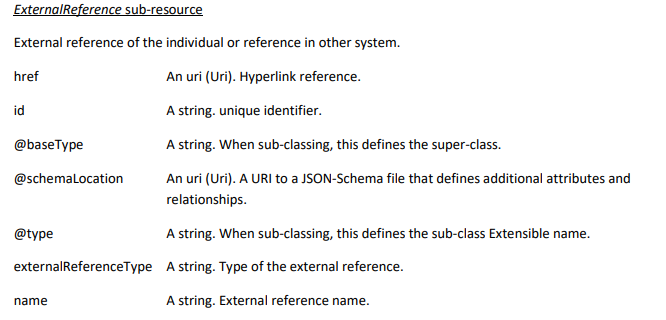 better to not change above attributes as its standardize one , its not mandatory to use all attributes in your system, which ever required use it in your system(Service Order API), if wants you can extend it with your specific attributes by adding new attribute in your local flavor in same Entity.
Mahendar
Capgemini
------------------------------
mahendar naik
TO BE VERIFIED